IQ & Analytical Reasoning for Entry Tests: Every Question Type, Explained
Ilmkaar Team
12 November 2026

The IQ or analytical reasoning section shows up in many Pakistani admission tests: it is 20% of FAST-NUCES's BS Computing and Engineering test, NTS's NAT-IE and NAT-ICS papers include a 20-question Analytical section, and many university papers have one too. Students often skip it because it isn't in the FSc syllabus. That's a mistake: the questions repeat the same few patterns, so a week of focused practice can turn it into your fastest section.
Here's every common question type, with a solved example and the trick to spot it.
1. Number series
Look at the differences first, then ratios, then alternating patterns.
Example A: 2, 6, 12, 20, 30, ? Differences: 4, 6, 8, 10 → next difference 12 → 42. (Pattern: n × (n + 1): 1×2, 2×3, 3×4 … 6×7 = 42.)
Example B: 3, 9, 27, 81, ? → each term × 3 → 243.
Example C (alternating): 5, 10, 8, 16, 14, ? The operations alternate: ×2, −2, ×2, −2 … → 14 × 2 = 28.
> [!tip] If the differences don't form a pattern, try the differences of the differences, then ratios, then two interleaved series (odd positions and even positions).
2. Letter series
Convert letters to their positions (A = 1, B = 2 … Z = 26) and treat it as a number series.
Example: A, C, F, J, O, ? Positions: 1, 3, 6, 10, 15 → differences 2, 3, 4, 5 → next is 15 + 6 = 21 → U.
> [!note] Memorise the positions E = 5, J = 10, O = 15, T = 20 and Y = 25 as anchors. It makes letter arithmetic much faster.
3. Analogies
Find the exact relationship in the first pair, then apply it to the second.
- Doctor : Hospital :: Teacher : School (person : workplace)
- Book : Author :: Painting : Painter (work : creator)
- Number analogy — 3 : 27 :: 4 : ? → 27 = 3³, so the answer is 4³ = 64.
Common relationships include part–whole, tool–worker, cause–effect, opposites, degree (warm : hot) and category (rose : flower).
4. Odd one out
Look for a property that all but one share: prime numbers, squares, vowels, categories.
Example: 2, 3, 5, 9, 11 → all are prime except 9.
5. Coding and decoding
Find the rule on the known word, then apply it.
Example A (letter shift): If PEN is written as QFO, how is BOOK written? Each letter moves forward one place (P→Q, E→F, N→O), so BOOK → CPPL.
Example B (number code): If CAT = 3-1-20 (letter positions), then DOG = 4-15-7.
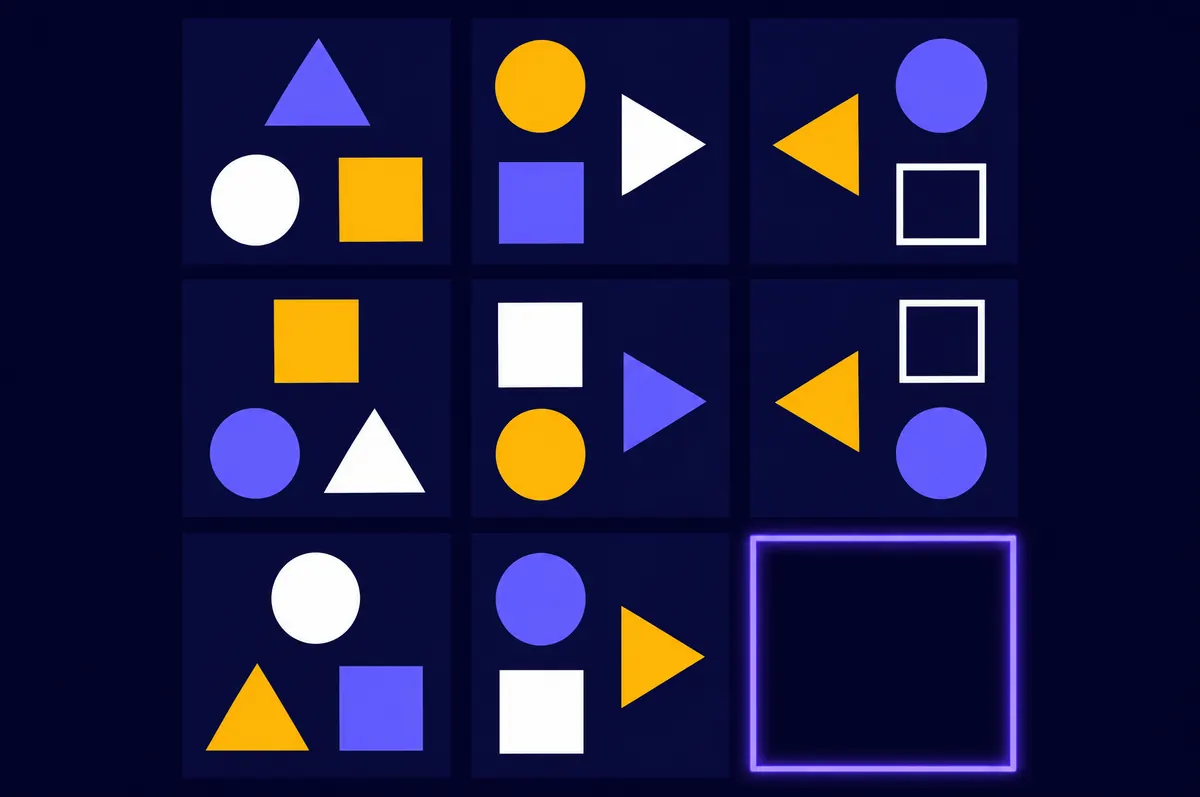
6. Shape and pattern matrices (non-verbal)
You'll see a 3 × 3 grid of shapes with the last tile missing. Check each of these, one at a time:
- Rotation — does a shape turn 45° or 90° each step?
- Count — does the number of dots or sides go up or down?
- Shading — does shading alternate or move position?
- Rows and columns — does each row contain one of each shape?
Checking one property at a time is far faster than staring at the whole grid.
7. Blood relations
Draw it. Even a tiny family tree removes the confusion.
Example: Pointing to a man, Sara says, "He is the son of my mother's only son." How is the man related to Sara? Sara's mother's only son is Sara's brother. The man is her brother's son, so he is Sara's nephew.
8. Directions
Sketch every move. Remember: facing north, right is east and left is west.
Example: Ali walks 4 km north, turns right and walks 3 km. How far is he from his starting point? He ends up 4 km north and 3 km east of where he began: a 3-4-5 triangle, so he is 5 km away, towards the north-east.
9. Clocks
The angle between the hands at H hours and M minutes = |30H − 5.5M| degrees (if the answer is over 180°, subtract it from 360°).
Example: At 3:30 → |30 × 3 − 5.5 × 30| = |90 − 165| = 75°.
10. Calendars
Use remainders after dividing by 7.
Example: If today is Monday, what day is it 61 days from now? 61 ÷ 7 leaves a remainder of 5. Monday + 5 days = Saturday.
11. Ranking and order
Total people = position from left + position from right − 1.
Example: Ahmed is 7th from the left and 12th from the right in a row. There are 7 + 12 − 1 = 18 people.
12. Syllogisms (logical statements)
Only accept a conclusion that must be true; "could be true" is not enough.
Example: All pens are tools. Some tools are blue. Conclusion: "Some pens are blue." → Does not follow. The blue tools might not include any pens.
Drawing quick Venn circles makes these almost automatic.
A one-week IQ practice plan
| Day | Practise | Target |
|---|---|---|
| 1 | Number series | 25 questions in 15 min |
| 2 | Letter series + coding | 25 questions in 15 min |
| 3 | Analogies + odd one out | 30 questions in 15 min |
| 4 | Blood relations + directions | 20 questions in 15 min |
| 5 | Clocks, calendars, ranking | 20 questions in 15 min |
| 6 | Syllogisms + pattern matrices | 20 questions in 15 min |
| 7 | Mixed timed test | 40 questions in 30 min |
After week one, do a short mixed IQ set two or three times a week so the patterns stay sharp.
> [!note] Ilmkaar has a dedicated IQ & Quantitative Reasoning subject with timed chapter tests, and your wrong answers are saved automatically to the Mistake Notebook for spaced revision. Start practising.
Frequently asked questions
Which entry tests have an IQ section?
FAST-NUCES's BS Computing and Engineering test gives "Analytical Skills & IQ" 20% of the paper (25% for its business programmes), and NTS's NAT-IE and NAT-ICS each have a 20-question Analytical section. NUST's current Engineering & Computing NET (Maths, Physics, English) no longer has a separate intelligence section, though older NUST patterns did.
Can you improve your IQ test score with practice?
Yes. Entry test IQ questions follow a small set of repeating patterns, so practising each type is very effective.
How long should an IQ question take?
Most should take 30–45 seconds. If you can't see the pattern in a minute, mark it and move on.
What is the fastest way to solve number series?
Check differences first, then ratios, then alternating (interleaved) patterns — in that order.
Related reading: 17 math shortcuts for entry test MCQs and our FAST NUCES section-by-section strategy.
Ready to put this into practice?
Practice real past-paper MCQs for Study and every major entry test — free to start, no card required.
Start Solving Free